Before we embark on a long (8 day) trip to Puno and points south, we're able to meet some new people in Cusco. Even though we've been here for nearly 10 months, we've just scratched the surface of the opportunities right in Cusco city and places close. It is our objective to travel to all districts of the mission, and hopefully we will be able to get that accomplished.
After the Sunday meeting block, we've got several appointments, including one with Gustavo Sr. and Gustavo Jr (, in the picture with Elders Ludlow and Barry). When we first arrived, we were somewhat confused by the Latin custom of names. When we understood it, it's actually quite helpful in building family trees. As examples, it's customary for every person to have 2 nombres (first names), and 2 apellidos (last names): Juan Carlos Sanchez Quispe. Juan Carlos are the obvious nombres, Sanchez is the first last name of his father, and Quispe is the first last name of his mother. It can also be written Juan Carlos Sanchez Q. If we identify a person with 2 apellidos, we can usually extend the line back one generation by splitting the names between father and mother.
With women, it can be a little more confusing. They will also customarily have 4 names in the same format: Maria Rosa Farfan Mendez. They will usually keep their birth names throughout their lives, but sometimes they will take their esposo's name in the form of Maria Rosa de Sanchez. It can be a little tricky, but certainly no more than tracking our custom of the wife taking the husband's name: Dawn Renee Johnson, or my Icelandic ancestor's patronimic custom where the father's first name becomes the son's last name: John Thorgierson > David Johnson. Except when it's a girl, then it's Johnsdottir. Or some places in Africa your last name is the day of the week you were born, or the place you were born near. Taken altogether, names and their traditions are an important and essential part of who we all are.

Hna Italia gets her family tree written on the white board, so we can see the connections before we try and get everyone in the right place on her Family Tree. Note that she's bundled up warmly, which is sometimes needed. The seasons are changing from cool/dry to not-so-cool/rainy, and we never know what each day will be like, so everyone dresses for the unexpected, which is likely to happen. Actually the recent weeks have been some of the most pleasant since we've been here - certain days excepted.
Our faithful and super-diligent Historia Familiar Specialistas in barrio Ttio: Hnas Martha, Pily, with Italia and Hna Missy, who is visiting with a humanitarian group, served a Spanish speaking mission, and is our translator for the day. Everyone who helps makes a great contribution to the work here.
Travel time. We're pros now. This is 8 days worth of "necessities", and everything is needed, especially Hna J's pillow for the 7 hour bus ride to Puno. We're getting on a "fast bus", which only makes one stop on the way. Fast is relative, because on the highway, there are speed bumps about every 5km, so everyone has to slow down to about 10kmh to go over them. Our bus is quite nice, and if someone offered a nonstop service down I-15 to St George, at the prices we are charged here, I would take it regularly instead of driving. Neither of us has been behind the wheel since we got here, will we be able to remember how to drive?

They take our picture when we get on the bus. I think this is so they can identify our remains if we have an unfortunate meeting with a herd of llamas crossing the road. This time, we get the front seats on the top deck, so we have a full view of the road ahead. This perspective helps Hna J avoid motion sickness, but even with this view, she still takes a dramamine when we get under way.
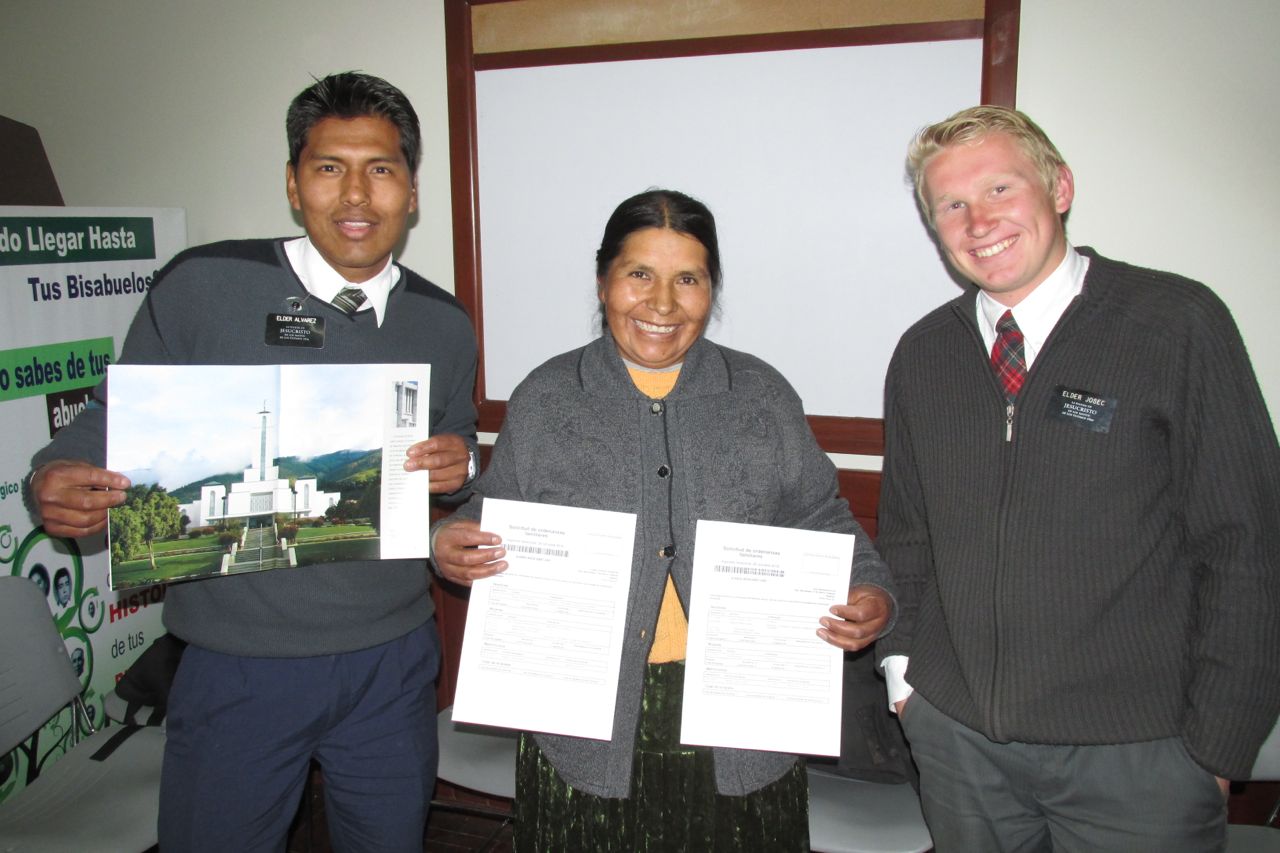
We arrive in Puno and get right to work. This time, our work was efficiently planned by the Zone Leaders so that all our meetings were in the chapels. Hno Grover is here for his appointment, giving thumbs up with Elder Alvarez. Elder Chang and Rafael have their hands on my iPad, which is very helpful for entertaining small children and elders while we're working with the parents.
Grover calls for some more information while Elder Alvarez supervises. Elder A. will be finishing his mission soon and returning to Bolivia. We have grown to love and appreciate him and his dedication. As one of the Zone Leaders, he had several opportunities this week to set an example for dedication and service, and he really shined!
Hno. Rosendo, Hna Maria, their hija Luz Paola and nieto Rafael had a great visit and it was a pleasure to meet them.
Hna Nidia has a double-handful of work to do at the Cochabamba Bolivia temple. Elders Alvarez and Johanson did great work today.
Hna Maria Lourdes Isabel + 3 apellidos sets a new record for 6 total names. She and Hna J engage in some animated conversation.
Everyone in the family gets involved with their own Mi Familia folleto.
Hna J poses with 2 of our new friends, Hna Maria and Hno. Felipe. Hna J has a supply of "Templos" magazines, and they are very popular and valued gifts when we finish a HF meeting.
4 big smiles from Hnas Gonzales, Rust, Danitza and J.
Hna. J writes the scripture of the day - in Espanol, if you look closely.
Puno is the land of green chicken foot soup, served with "pollo abrazo" or roasted chicken in 1/4, 1/2, or whole. Elder Johanson can put away 1/2 easily. Hna J's warning: Look out for toenails in the bottom of the bowl. Chicken foot soup ranks right with Cui in my scale, but they're both part of the tradition and heritage here, and add to our list of adventures in dining, excellent in Puno.
Hna J. needed a little extra time one morning, so I brought up some breakfast from the great buffet that our hotel provides.
That evening, we had some appealing and tasty appetizers at La Casona. Don't think that all the great food is in the US or Europe. There are exquisite and tasty dishes reflecting local culture and traditions all over the world, and Peru has its share.
Including taqueños, recommended by Presidente Harbertson.
Missionary work is hard on shoes, as this quartet of elders will attest.
The Peruvians have lots of holidays, and they don't need much of a reason to get the bands and dancers going. This was a big event, many hundreds of participants, lots of dignitaries on the stand watching, and it was great entertainment for the tourists who are here in surprising numbers to visit Lake Titicaca. October must be Scandinavian month, as there were large groups and individuals here from the Nordic countries. This event was sponsored by one of the big schools in Puno.
Any time the crowds gather, the street vendors will be there. The skewers of meat, potatoes look and smell very good, but alas, due to the less-than-sanitary methods used for storage, prep, cooking, and serving, we stay away from this food. A skewer of carne with a papa on top is 3 Soles, less than $1.
What's this?? GREEN JELLO?? Are we in Utah? Just goes to show that Utah is the trend-setter for the entire world. Or else these treats are really cheap, 1 Sole or 30 cents. Unfortunately we pass on these as well. The Peruvians even have their own version of Funeral Potatoes.

Due to some unforseen and aggravating technical problems (WiFi phone malfunction), we have to cancel our planned day to Juliaca, but we get the phone working again, in time for a quick afternoon dash down to Ilave, about 45km south of Puno, toward Juli and Bolivia. It turned out to be a great day, and Hna Melisa gives herself a thumbs-up when she sees her family names go from her Mi Familia folleto to familysearch.org. The combi ride from Puno > Ilave is 3.5 Soles x 2 = $2 for both of us. Trying to get home late that night, the combis were not to be found (unusual, they are typically everywhere), so we're trying to figure out how to get back to Puno. While we're standing there in the dark, a taxi pulls up and asks if we want to go to Puno? Sure, how much? 7 Soles, or what a combi would have cost. I think he just needed to get back home to Puno that night. There was one other passenger in the taxi, but it was a fast ride back. And for an extra 3 Soles, the driver delivered us right to our hotel.

Our last session in Puno was one of the most organized and productive we have ever had. It was a combined effort between 2 bishops, the Zone Leaders, and the Stake Historia Familiar Specialista, Hna Choquehuanca. We are set up in a room with a big desk, 2 laptops (1 plugged into the flat screen TV), printer and other accessories. There is another near-identical setup in the room across the hall, run by Hna C. We go 4.5 hours straight with only 1 short break. The members show up 4 every 1.5 hours. Hna J drives one computer . Note Elder Alvarez on the other: Hna Zoila had reference numbers to original vital documents that had been photographed and indexed (our great thanks to all who do this, we love you and your work is invaluable in Family History). Together, they worked quietly for about 2 hours reading and transcribing the names, dates, and places on the documents into familysearch.org. Only a couple of questions to me during that time. When finished, I peeked over Elder A's shoulder, and everything was done correctly and in the proper place. Elder Alvarez will be a great leader and give much strength to the Church in Bolivia when he returns, and we will miss him.

We're finished up on Saturday night, at the end of a long, but productive and very enjoyable day. Hna Choquehuanca gets our thanks for her dedication and leadership in HF work in the Puno area. She had a lot of questions, and we were able to help her out with some technical details. She is a little fireball of enthusiasm and we know the work will move forward here with her in charge.
We've had nearly a week's worth of adventures, in Puno, but they're not over yet. On Sunday morning we just in a combi with the Haslers and head to Juli in the southern tip of the mission. There is an Area Conference broadcast all over Peru and Bolivia on video, and we're going to attend there, plus we have several HF appointments scheduled after the conference. Combi rides are always cozy, but they can be a lot of fun - if they don't last for more than an hour and a half.

After the conference, we move to an upstairs room and start to meet the people who have made appointments to see us. Hna J and Andrea are working in the back, and Hna Hasler is helping Hna Bernardina in front. Hna B is full Aymara, whose people have lived in the area around Lake Titicaca for hundreds of years or more. They are similar, but distinctively different than the Chechua/Inca. The Aymara had enough strength that they were never conquered by the Chechua, but became part of the loose confederation of the Inca, and developed trade relationships with each other. To this day, there is a distinction and definite pride of heritages between them. Hna B. is in her Sunday best, the Aymara and Chechua have decorative, traditional, and distinctive hats, shawls, and dresses There were a number of other women in the same style here today, but unfortunately I didn't get photos before we were whisked upstairs.

When we were finished, Hna Bernardina was so happy that she insisted on putting her hat and shawl on Hna J, and posing for a picture. This photo conveys the love that we have for the wonderful people here, and they for us. It is a privilege to be here and help them.
Stay tuned - a big announcement may be coming next week!